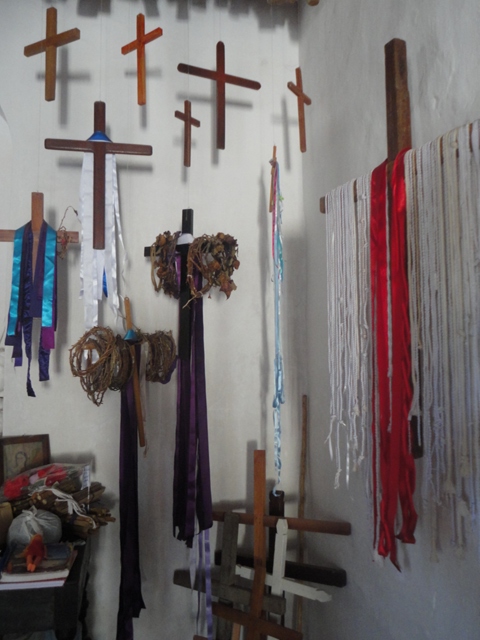
No Brasil, há uma
vasta série de artefatos que são confeccionados e absorvidos por um mesmo
segmento da população regional ou vicinal. Todos ali detêm um conhecimento
compartilhado do seu significado. Estão neste caso os ex-votos ou “milagres” do
sertão nordestino, modelados secularmente em barro ou esculpidos em madeira,
expressão de fé pela graça recebida de um santo católico. Faz-se a promessa, o
voto. Atendido o pedido, cumpre-se a obrigação de dar testemunho do “milagre”,
o ex-voto, que pode assumir infinitas modalidades. Em geral é no quadro da
romaria que o pagador de promessa cumpre seu voto. Verifica-se a ação
institucional da Igreja católica como organizadora das cerimônias formais que
tradicionalmente constituem parte essencial desses ritos (missas, novenas,
confissões, comunhões). Ao lado delas, porém, há os módulos de representação
próprios do povo comum, que geralmente assumem a forma de comunicação direta
com o santo padroeiro, sem a intermediação do sacerdote No Nordeste,
dão testemunho disso as inumeráveis cartas escritas ao santo e colocadas na
igreja de sua invocação e o pagamento de promessas de diversa ordem, como o
carregar de pedras na cabeça no acompanhamento da via-sacra e de procissões, o
cumprimento de obrigações sob a forma de músicas cantadas na Sala dos Milagres,
de corte de cabelo, de vestição e entrega de “mortalhas” (hábitos de santos),
bem como figuras esculpidas em barro ou madeira. E ainda a entrega de
fotografias, jóias, espigas de milho, cabelos, óculos, cadeiras de rodas,
muletas, diplomas de formatura, livros escolares, peças de renda, cartas,
flores, navios, placas com inscrições, mamadeiras, velas, vestidos de noiva,
grandes cruzes de peregrinação, enfim, uma variedade inesgotável de objetos que
corresponde à multiplicidade das situações vividas pelos ofertantes. Caminhando
a pé enormes distâncias ou transportados em caminhão, romeiro de ambos os sexos
e todas as idades muitas vezes fazem retratar por fotógrafos que seguem o
roteiro das peregrinações para possibilitar aos fiéis a oferta ao santo, também
como ex-voto, da foto que, no Sudeste do país, já substituiu praticamente o
“milagre” pintado ou esculpido, juntamente com objetos de cera, moldados em
série, reproduzindo partes do corpo humano.
"Pequeno
dicionário do povo brasileiro", de Lélia Coelho Frota"
In Brazil, there are many different crafts made and absorbed by the same
segment of the regional or local population. There they all have a shared
knowledge of their significance. In this case, they are the ex-votos or
“miracles” of the north-eastern backlands, for centuries modeled in clay or
carved in wood, an expression of faith for the grace received from a Catholic
saint. The promise, the vow is then fulfilled and provides evidence of the
miracle, the ex-voto, in all shapes and sizes. In general, who pays the promise
fulfills his or her vow on a pilgrimage. We can mention São Francisco das
Chagas from Canindé and Juazeiro do Norte, both in the Ceará state Bom Jesus da
Lapa, Bahia state, Círio de Nazaré, Pará state, Bom Jesus de Matosinhos, Minas
Gerais state, Aparecida do Norte, São Paulo, as some of the largest pilgrim
centers in Brazil where this practice is commom. There the institutional action
of the Catholic Church can be seen as an organizer of formal ceremonies that
traditionally are an essencial part of these rituals (masses, novenas,
confessions, comunions). Alongside them, however, are the ways in which the
common people present them, which generally take the form of direct
communication with the patron saint without the priest’s intermediation. In the
Northeast, this is evident in the numerous letters written to the saint and
placed in the church of its invocation, and the payment of promises in
different ways, such as carrying stones on their heads as they follow the
Stations of the Cross and processions, fulfilling vows in the form of music
sung in the Hall of Miracles, cutting hair, wearing and offering “mortalhas”
(sacred habits) to the patron saint, as well as figures modeled in clay or
carved in wood. And also submitting photographs, jewelry, corn husks, hair,
eyeglasses, wheelchairs, crutches, graduation diplomas, school books, pieces of
lace, letters, flowers, ships, plaques with inscriptions, baby bottles,
candles, wedding dresses, large pilgrimage crosses, in short, and endless
variety of objects corresponding to the many different kinds of situation
experienced by the devout. The pilgrim of all ages, men and women, go long
distances on foot, or ride on trucks, very often have their portraits taken by
the photographers that follow the pilgrims’ route, to enable the faithful to
offer the photo to the saint, also as an ex-voto. In Southeast Brazil this
practice has already practically substituted the painted or carved miracle,
together with wax objects, shaped in series, reproducing parts of human body.
The girl who has her photo taken beside a sheep in Canindé, ordered by
the family, will offer the animal to St. Francis to fulfill a promise. It is
also common to submit no mandatory ex-votos in the small country-sides chapels
or shrines built in the vastness of the backlands.
In the State of Bahia, the famous festival of Senhor do Bonfim is held
in its church in the city of Salvador. The church was built on Itapagipe Hill
in the 18th century to house the miracle-working figure of Christ on the Cross
brought from Portugal in 1745. Since then, it has become one of the most
popular religious centers in the state, and includes African-Brazilian rituals
in its festivities. In Riscadores de Milagres (1967), Clarival do Prado
Valladares studies the church’s constant incoming ex-votos, carved or in
silverwork, or painted votive plaques, a practice that was common until the
20th century. Mention should be given to the role of João Duarte da Silva
(1860-1935) in votive plaques. He was a barber and riscador de milagres
(miracle sketcher) and nicknamed João Pinguelinho, living in Taboão, the center
of popular art production in Salvador. Among other activities, João Pinguelinho
would sign his painted ex-votos, by the pseudonym of Toilette de Flora, and
would keep up-to-date the centuries-old tradition of the painted miracles
relating to rescue from shipwrecks.
In Southeast Brazil, in Aparecida do Norte, Bom Jesus do Matosinhos, and
other pilgrimage centers, many painted ex-votos were made in the 20th century.
Dating from 1900 is an example of the miracle made by the boy Godofredo, who
had swallowed a nail, and in 1922, for example, the continuity of earlier
centuries of the miraculous facts relating to occupational accidents: Davi
Ramalho is grateful for being cured and shows the actual machine that injured
him, now in full industrial context.
Notwithstanding the beauty and great interest of the painted ex-votos
for history of art and cultural studies in Brazil, from the view-point of
visual creation, it is unique in the 20th century Western world the original
synthesis offered by the known variety of Northeastern ex-votos shaped in clay
and wood. From the endless plastic invention, these sculptures of faith by
anonymous artists in the backlands of Northeast Brazil, or accosionally by
artists such as Vitalino, and Master Dezinho, for example – for no payment,
since it was a vow – were displayed in exhibitions in Brazilian museums during
the 20th century, and in the art galleries and cultural foundations in Europe
and the USA.